Sustainable construction in the Czech Republic
Sustainable construction in the Czech Republic: Why timber construction is the key to decarbonization
Timber construction is experiencing dynamic growth in the Czech Republic, particularly in the residential sector. While these structures accounted for only 1.4% of all newly completed single-family homes in 2000, their share had reached 14.1% by 2022. Although the Czech Republic still lags behind European leaders like Sweden (up to 90% of new residential buildings), Austria (33%), and Germany (approx. 20%), the interest in high-quality, sustainable wood as a building material is growing significantly.
This trend is more than just a passing fashion; it is part of a broader construction transformation focused on lowering energy consumption, utilising sustainable materials, and reducing the overall carbon footprint of buildings. Thanks to their unique properties, modern timber structures are naturally becoming a crucial element in this sustainability revolution.
It is in this context that the Zero Carbon Roadmap from the CZGBC (Czech Green Building Council) is fundamental. This roadmap offers concrete strategies and solutions for how the Czech Republic can progressively move towards the complete decarbonization of its building stock by 2050, integrating modern materials, innovation, and energy efficiency.
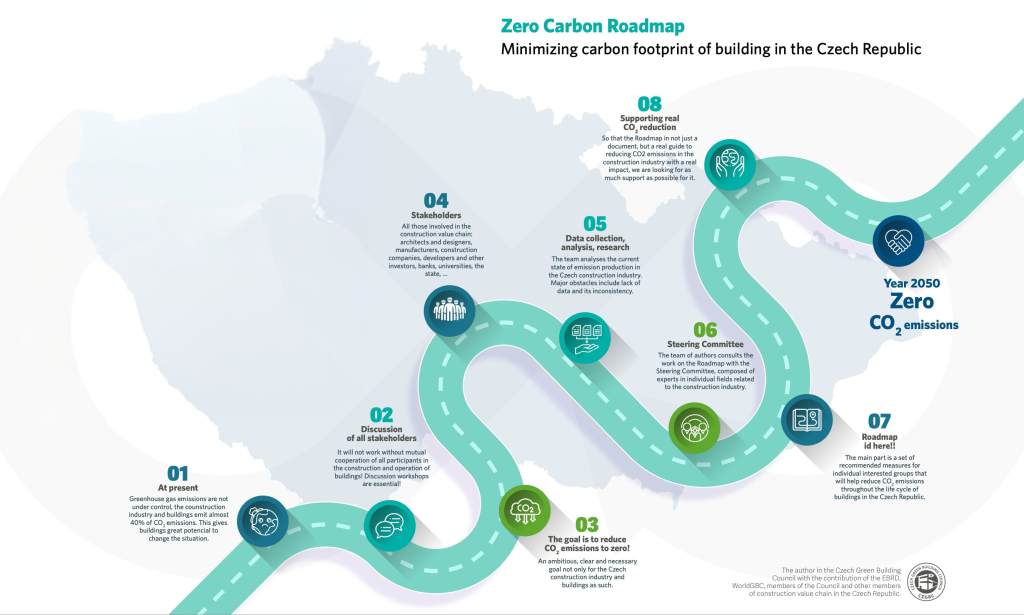
CZGBC Zero Carbon Roadmap: Strategy for climate-neutral buildings
The Zero Carbon Roadmap presents a comprehensive strategy for the decarbonization of the Czech building stock by 2050. It emphasizes that this is a systemic change requiring the cooperation of the state, municipalities, experts, and developers.
The key lies in high-quality legislation, a predictable investment environment, and support for innovations that reduce emissions across all phases of the building lifecycle (manufacturing, construction, operation, renovation, and demolition).
To achieve these ambitious goals, a holistic approach is necessary across ten key areas, including:
- Strategic management (unified national strategy, action plans)
- Stable legislation (timely transposition of EU directives, clear interpretation of the taxonomy)
- High-quality and rapid building renovation (inter-ministerial coordination, stable subsidies)
- Exemplary role of the state and local administrations (green public procurement, responsible building management)
- Reducing embodied carbon (support for the decarbonization of material production, new technical standards, emissions database)
- Development of low-emission energy (support for renewable energy sources (RES), modernization of heating)
- Integrated energy planning (unification of plans, municipal support)
- Research and innovation (smart grids, energy storage, low-emission materials)
- Education and workforce (strengthening sustainability in education, retraining)
- Public awareness (long-term campaigns to increase awareness)
This holistic approach demands coordination among all stakeholders. Many businesses are already moving towards these goals, but the crucial role now belongs to state institutions, which must ensure stable conditions for the further development of sustainable and low-emission construction in the Czech Republic.

The role of timber construction in achieving the Zero Carbon Roadmap goals
The Timber working group, in its document “The Future of Timber Construction” (CZGBC), clearly defines that the massive expansion of timber construction is not merely a matter of architectural preference, but a necessary step for fulfilling the ambitious goals of the Zero Carbon Roadmap.
Timber construction presents a systemic and immediate solution that addresses several key pillars of the Roadmap:
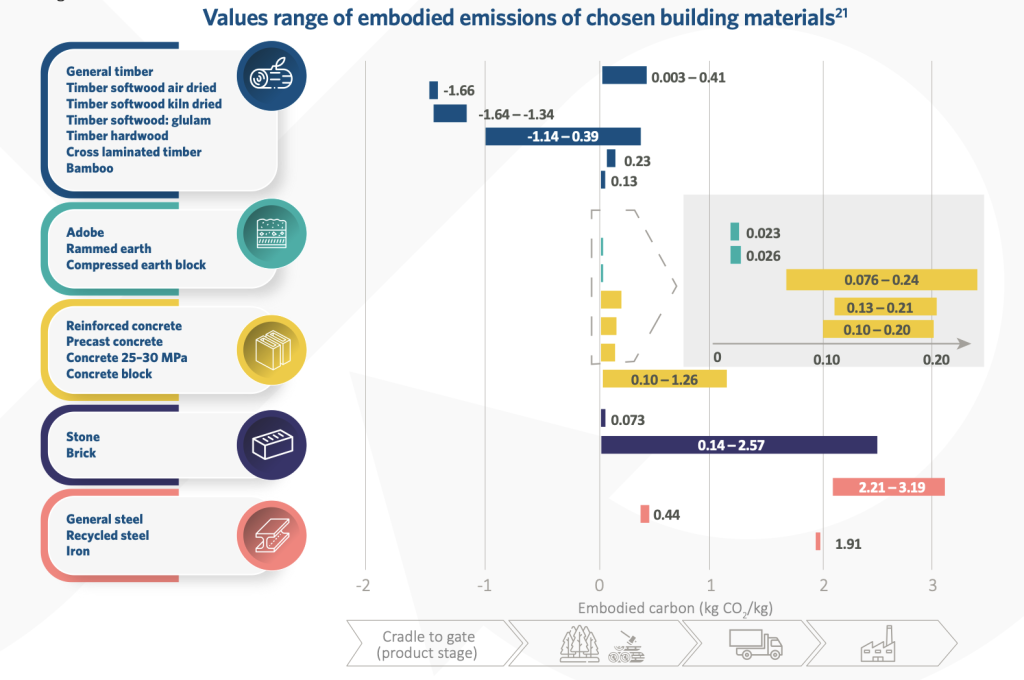
- Low carbon footprint: Timber structures naturally have a lower carbon footprint compared to concrete and steel, directly contributing to the reduction of greenhouse gas (GHG) emissions across the entire building lifecycle.
- Energy efficiency: Thanks to the excellent insulation properties of wood, timber buildings achieve higher energy efficiency and significantly reduce the energy required for heating and cooling.
- Material sustainability: The use of certified timber from sustainably managed forests aligns with the principles of the circular economy and supports the overall sustainability of the construction sector.
- Innovation and technology: Modern prefabricated wooden panels and CLT (Cross-Laminated Timber) technologies are examples of innovative approaches that accelerate the transition to low-carbon construction and enhance building quality.
Timber construction statistics in the Czech Republic
In 2023, 17,809 single-family homes were constructed in the Czech Republic. Although the total number of newly built single-family homes saw a 5% decrease compared to 2022, the number of timber structures declined by only 2%. This ultimately led to a further increase in the share of timber structures in the total number of new single-family homes to 14.6%, confirming their steadily growing popularity among Czech residents.
Breakdown of new-built timber constructions by structural system:
- Light timber frame structures: 85,8% (43,7% prefabricated panel assembly, 42,1% on-site assembly)
- Log and round log: 7,0%
- Mass timber panels: 6,6%
- Heavy timber frame structure: 0,7%
Globally, the Czech Republic’s 14% share of new single-family homes built from timber places it right at the European average (based on 2021 data). It is also important to note that the share of timber structures in the multi-family housing (apartment buildings) category remains minimal in the Czech Republic (<1% and only a handful of units annually). In 2023, only 6 apartment buildings with a timber load-bearing structure were completed out of a total of 557 completed apartment buildings. This represents an enormous potential for future development.
ZEO Homes – Part of the journey to sustainable construction in the Czech Republic
Timber construction has become an indispensable element of modern and sustainable building in the Czech Republic, evidenced by its growing share of nearly 15% of new single-family homes. This trend, which is crucial for achieving the goals of the CZGBC Zero Carbon Roadmap through the reduction of the carbon footprint and increased energy efficiency, is fully aligned with our vision at ZEO Homes.
We are proud that, as an active player on the market, we contribute to this shift, helping the country catch up with leading European nations. We constantly work to ensure our homes are even more ecological, energy-efficient, and technologically advanced. At ZEO Homes, we are not only committed to the path toward net-zero carbon emissions, but we actively seek new processes, materials, and innovations that move the entire sector towards a more sustainable future and offer healthier and more efficient homes for future generations.